A fresh session
Kiln starts a new agent session in the feature’s own worktree, pointed at the next phase document. It says only what you would have typed yourself.
Kiln · the unattended build for the Enso Method
Kiln builds a PRD you already planned with the Enso Method, one phase after another, with nobody sitting in the loop. Every phase gets a fresh agent session. Git confirms it landed before the next one starts. At the end, delivery and test audits check the whole PRD, with pull requests for any work still awaiting your review.
You come back when it’s done, or when a phase genuinely needs you.
Where Kiln fits
The Enso Method puts the hard work first. Before anything is built there is a PRD in business language, a technical design checked against the real code, every open question answered or written down as an assumption, and a plan cut into phases small enough for one session. That half deserves your attention, with a pause to review wherever a decision is yours.
The other half used to need a babysitter. Start a session, watch it, say commit and push, paste the continuation prompt into a new chat, and do it all again. A dozen phases meant a dozen interruptions spread across a day, and none of it ran overnight. That half is what Kiln takes off your hands.
You and the method, pausing to review
Kiln, unattended, from Start to pull request
each phase · build · deliverable review · test hardening · commit · refactor pass · push
How each phase runs
Kiln starts a new agent session in the feature’s own worktree, pointed at the next phase document. It says only what you would have typed yourself.
Build, review, harden the tests, commit, tidy and push. The Enso Method skills run exactly as published. Kiln never edits them and never steps into the engineering.
The phase document is closed, everything is committed, and the branch matches origin. All three pass or the phase isn’t done, whatever the session said about itself.
Kiln reads the plan again and starts the next phase. When the last phase closes, delivery and test audits check the whole PRD. Required repairs get another audit cycle before Kiln finishes.
When it needs you
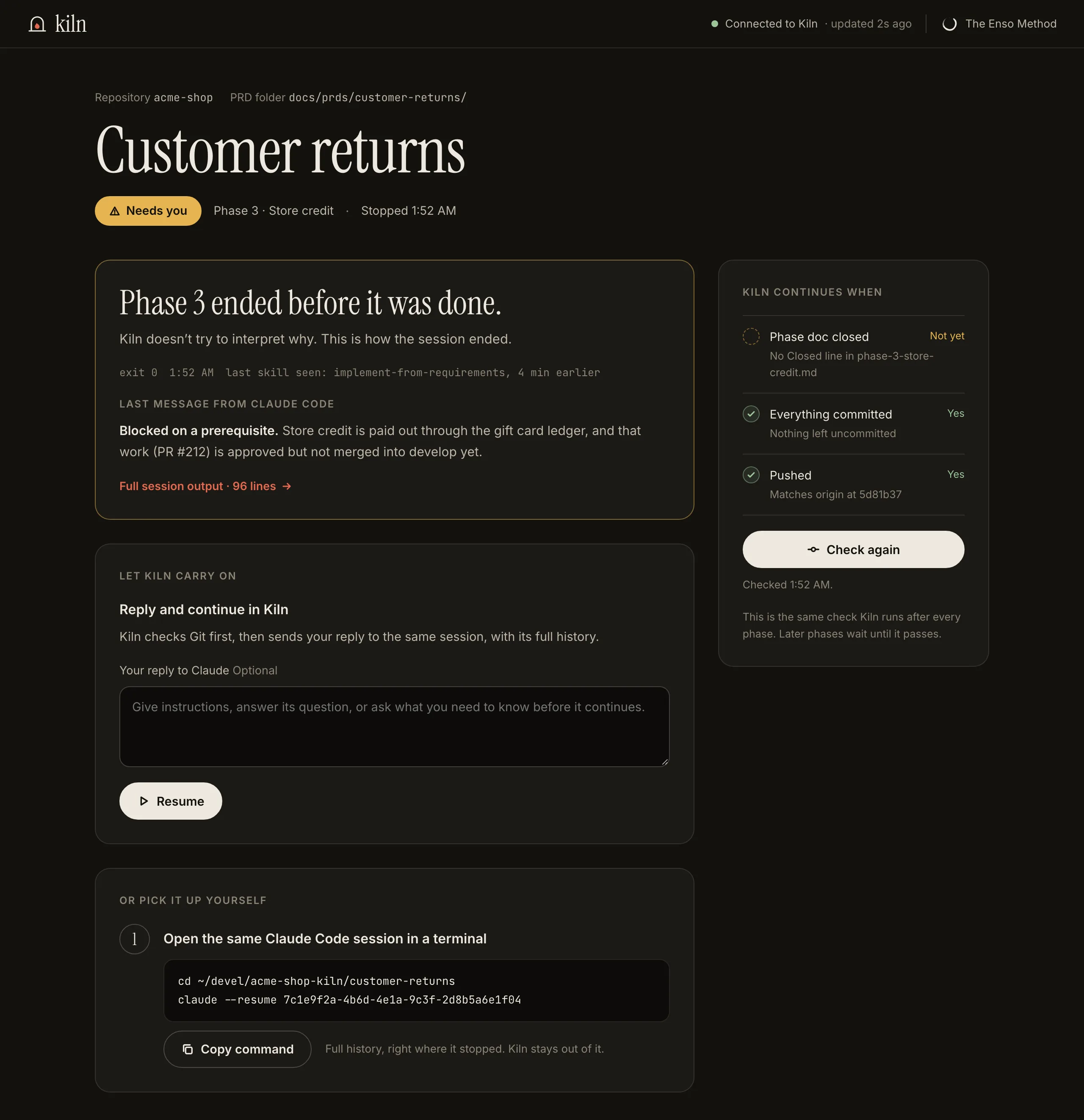
When a phase needs you, Kiln shows how the session ended and what is missing, then hands you the way back in. Usage limits have their own automatic wait-and-resume path.
Never a summary, and never a cause Kiln made up. Each failed check comes with the fact behind it.
Type a reply and Kiln sends it to the same session, with its full history, and carries on. Or one command resumes it in your terminal, to finish the phase there, in a new chat, or by hand.
The same three checks run. If the phase is done, Kiln carries on with the next one.
A bot that runs on your Mac and can use the terminal can drive Kiln too. It can tell you how each run is going, bring you the exact stop message, and send your answer back, and the phase picks up where it stopped.
Built to keep going
Ctrl+C, a closed terminal, a restart or a laptop that went to sleep. Run the same command and Kiln resumes the interrupted session.
When a session hits your plan’s limit, Kiln waits for the usage to come back and resumes that same session, rather than stopping for you.
Follow each tool call and message as it happens, with the session’s model, effort and commits, and your account’s usage beside it.
The current phase finishes, commits and pushes, then nothing new starts until you press Start again.
When the work spans repositories, each gets its own worktree and feature branch, and its own pull request at the end.
Choose the agent for each PRD, and the model and effort for its sessions. Model changes apply from the next phase.
The review is still yours.
By default, Kiln commits and pushes to feature branches and leaves pull requests for your review. Before Start, you can separately approve exact development targets; Kiln may then merge and deploy to those approved development environments. Production deployments and destructive actions remain unauthorized. The screen shows the delivery authority before you start.
Start to finish
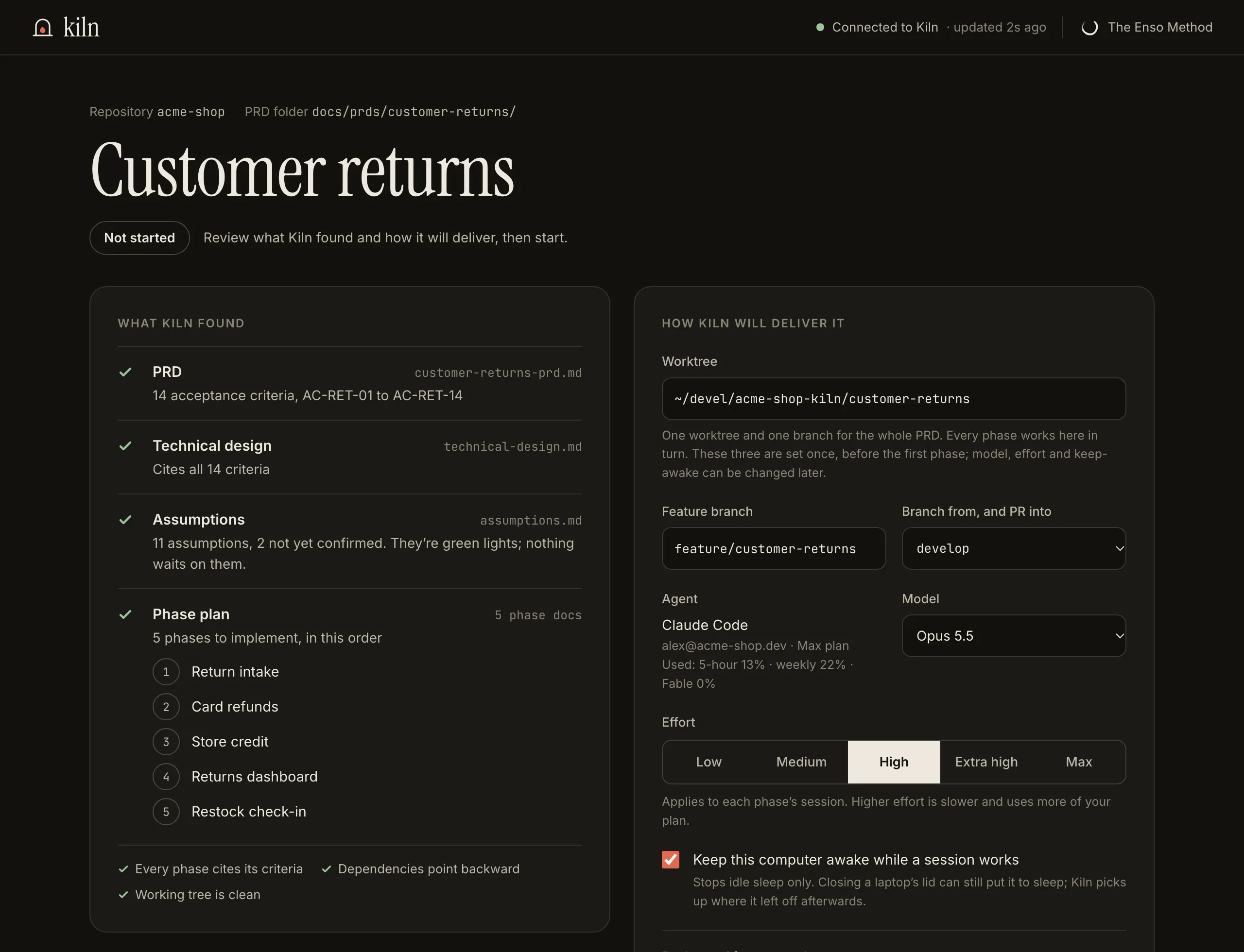
Kiln checks the documents and shows what it found, the branches it will use, and what it may do. Nothing runs until you press Start.
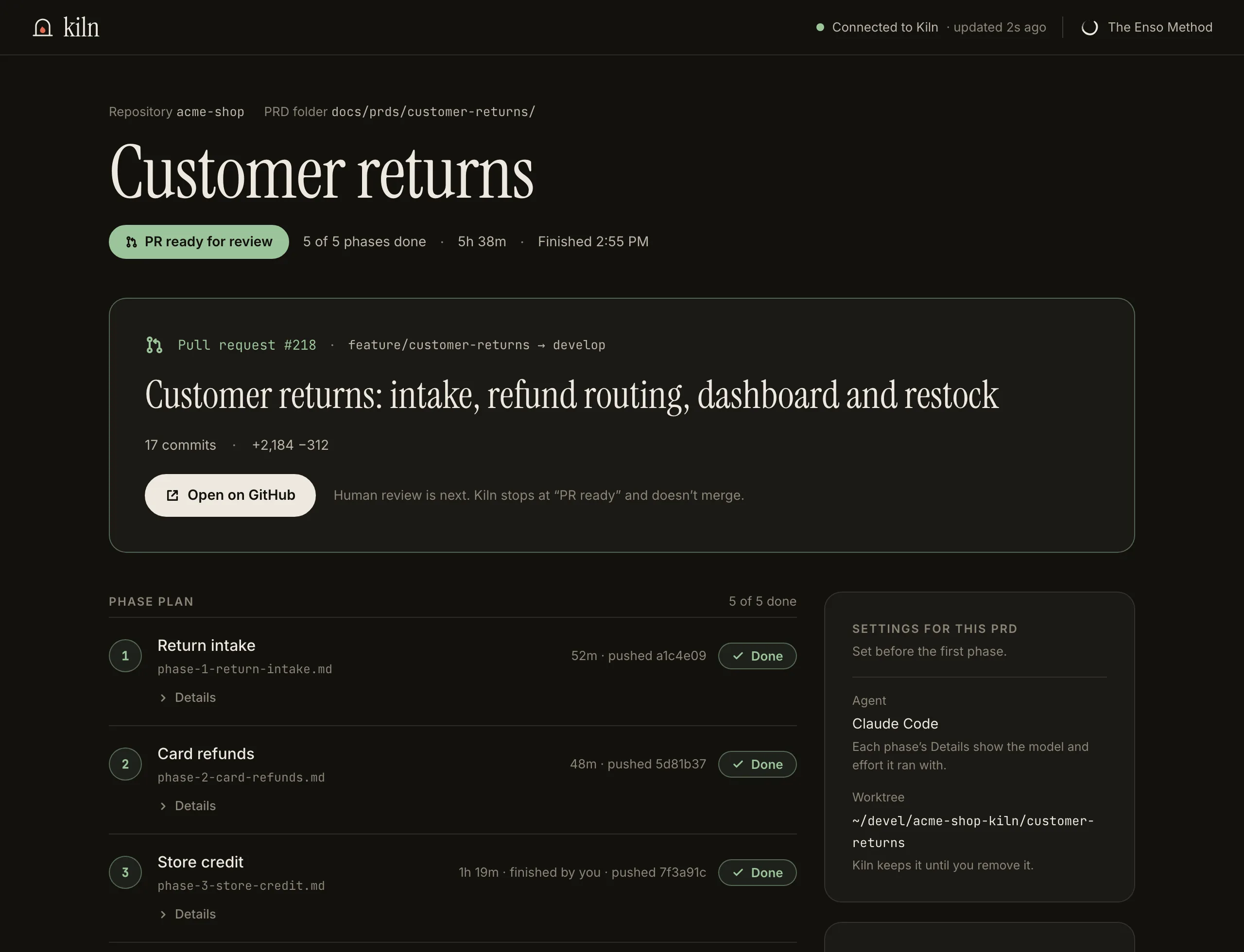
With the default delivery settings, the feature is built, reviewed, tested and pushed, with its pull request waiting for you.
Optional by design
Everything Kiln does, a person can do by hand in an ordinary session with the same skills. Nothing in your repository depends on it, and it writes nothing the skills don’t already write.
The name is a step in the craft. Everything is shaped before it goes in, and the kiln is where it sets.
Get started
Kiln needs Node.js 22.15 or later, Git 2.29 or later, the GitHub CLI signed in, and Claude Code 2.1.311 or later, signed in, or Codex 0.162.1 or later, signed in through ChatGPT, with the Enso Method skills installed. Codex on Windows also needs PowerShell 7.5.2 or later. macOS is the validated platform; Windows and Linux are best effort, with native issues handled as users report them.
npm install -g @ensodynamics/kilnWrite the PRD, refine it, write and review the technical design, refine that, and split it into phases. How it works
kiln run docs/prds/<name>